Where Were You...
…when the world met the hobbit?
I mean the fossil kind, not the ones from the Shire who love second breakfast.
When I first started researching the story of Homo floresiensis nearly a decade ago, people kept telling me where they were when they first heard the news that a tiny human relative had been found in Indonesia.
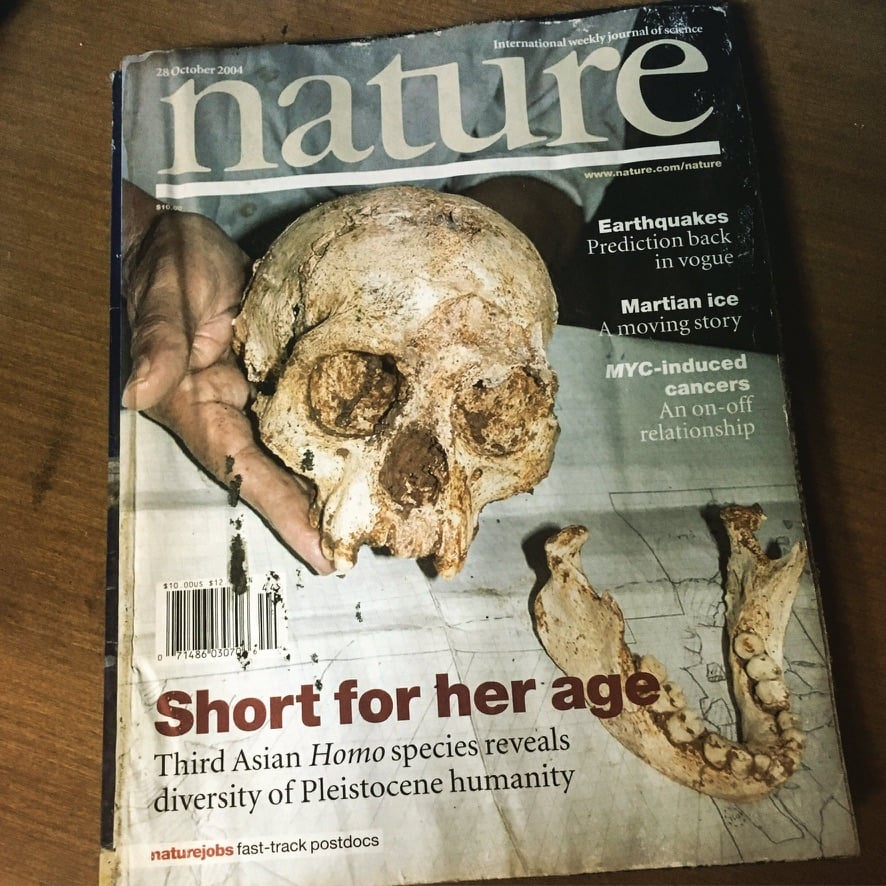
It was twenty-two years ago this week, in October of 2004, when her bony face appeared on the cover of the science journal Nature. The team of scientists had already been calling her “the hobbit,” and the coverage came, of course, with the first of many jokes about her size. She was a full-grown adult standing no taller than the average four-year-old, just over a meter.
After several people volunteered their stories, I started asking for them. I’ve collected the anecdotes like small historical gems, hoping they might let me step inside a moment I was too young to really experience myself.
Some people were thrilled. Matt Tocheri, then a PhD student, was at a conference with other paleoanthropologists when the words glided across the bottom of a television screen. “What a time to be alive,” he exclaimed. Looking back, the reaction seems to foreshadow what came later: through a wildly random chain of events, he ended up joining the research team on Flores.
Others were in disbelief, even denial. One scientist wondered whether the strange find was actually a hoax. Anthropology had seen big claims fall short before, and it had seen a carefully crafted fraud fool the scientific community for decades.
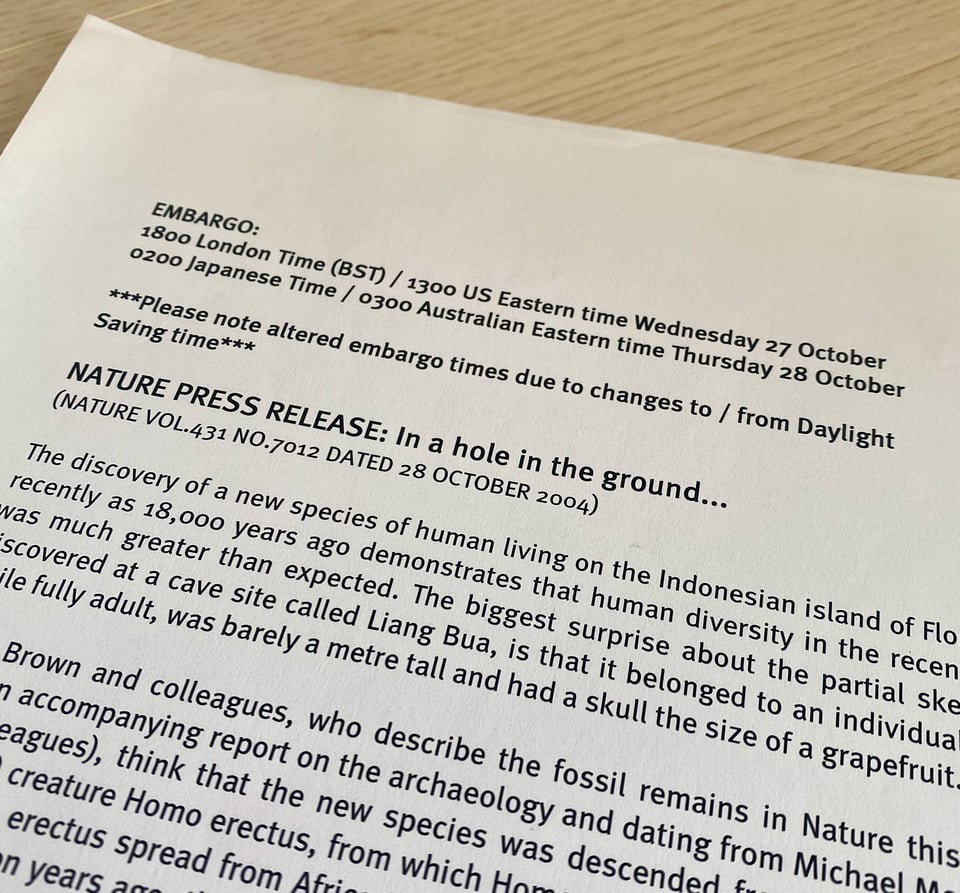
Whether science enthusiasts were giddy or horrified by the news, I think their memories are so vivid not because she made front pages around the world — though she did — but because her existence was so utterly unexpected.
Why, though? When I put myself back in 2004 to understand the shock, I often come back to the idea of a perfect storm. Here was a human relative found in seemingly the wrong place, living at seemingly the wrong time, and seemingly making the wrong kind of tools for her small brain. On top of all that was her tiny size.
Taken together, it meant confronting the idea that another kind of human may have shared the planet with our own species until surprisingly recently. A human that managed to survive despite its apparent lack of brain power and brain size.

More than two decades later, some of the details have changed. We no longer think her species hung on as long as we once did. The dates at the cave of Liang Bua have been revised from a disappearance of 18,000 years ago to about 50,000 years ago. Her tools, too, have been cast in a new light. They no longer appear as advanced as they first seemed.
Even with the revisions, though, she’s still pretty mysterious. 50,000 years ago is remarkably late for a human relative who is so small-brained to be living on an island that’s so incredibly hard to reach.
Somewhere along the way, this discovery has helped change how we think about the human story more broadly. We now recognize that the past was populated with many species of humans sharing the planet — and sometimes the landscape — with our own. Like Middle-earth, ours was a world “full of strange creatures beyond count,” as J.R.R. Tolkien put it. It’s what I’ve spent the last few years writing a book about: Strange Creatures, out next August.
If you’re a human origins nerd, you might have your own hobbit story. Where were you when you heard the news? Please share in the comments; I could always use more gems.
P.S. This newsletter has moved from Substack to Buttondown. You’re already subscribed, so nothing changes on your end.


Add a comment: